
A look inside the Maternity Ward
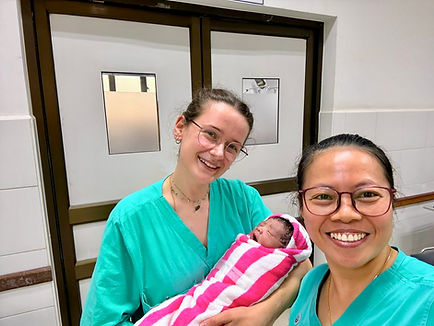
I was able to spend a month at the Jayavarman VII Maternity Hospital in Siem Reap. Women from distant provinces come to us every day to give birth here. Just as in other Kantha Bopha hospitals, care related to pregnancy and childbirth is free of charge. The obstetrics teams work around the clock here. Over 50 births every day. That’s a number I could hardly have imagined before my internship, since until then I’d only been familiar with obstetric care in Swiss hospitals. On my very first day, I was able to witness births up close, learn how any birth injuries in the women are treated, and see how the newborns are swaddled in their colorful cloths.
While several women are giving birth at the same time in a delivery room, another dozen women who are also in labor are already waiting outside in the hallway. It was definitely a scene I wasn’t used to seeing in Swiss obstetrics. But I quickly got used to it and learned not to lose focus despite the large number of births happening simultaneously.
“Work with your hands AND especially with your heart,” Dr. Kongkea Neav, one of the doctors at the Maternité, told me during my first week. With incredible dedication, she and her team care for countless women—depending on the rotation, either during outpatient appointments for prenatal ultrasounds or later in the delivery room. No matter how many patients there are each day, every single woman should receive the best possible medical care. At the Maternité, it’s not just about the well-being of the newborns but just as much about the new moms.
The high volume of patients also requires a well-organized division of tasks. The doctors at the Maternité rotate continuously through their daily duties: from the outpatient clinic to the delivery room and the operating room for cesarean sections to caring for inpatients. Another important task is performing ultrasound examinations, during which I was also able to assist the doctors.
The first ultrasound examination usually takes place during the first trimester of pregnancy to confirm the pregnancy. This is followed by another examination, known as organ screening. However, it is often the case that patients do not seek care until the pregnancy is well advanced, and a congenital heart defect, for example, is not discovered until shortly before delivery.
Congenital heart defects, neurological abnormalities, limb malformations, and other congenital anomalies are detected almost daily during ultrasound consultations, which is why this type of examination is so important. Of course, it is equally important to inform expectant mothers about the heart defect, for example, and to discuss together how to proceed. Early planning and consultation with the cardiac surgery team even before birth are essential in these cases. This is because, after birth, an initial, more detailed cardiological examination or even prompt surgical treatment is often necessary. Fortunately, the Children’s Hospital has its own cardiac surgery department, so both mother and child are in the best hands here.
I was particularly impressed by the doctors’ expertise in fetal medicine and ultrasound. So it’s no surprise that even doctors from other hospitals across Cambodia come to Siem Reap to expand their knowledge and skills in using ultrasound equipment. My personal highlight, however, was definitely seeing how much joy we were able to bring to the expectant mothers the moment they saw their child on the ultrasound screen.
During these four weeks at the Maternité, I was able to learn an incredible amount and gain valuable experiences and insights that will stay with me for the rest of my life. It’s remarkable to see the work that’s done here day after day to ensure that mothers and their babies can go home safe and sound. I’m grateful that I was able to play a small part in that for a month.
Warm regards from Siem Reap
Sina



What a heartwarming look into the maternity ward! It’s truly inspiring to see how dedicated the staff is. How do you think nutrition, like what we get from foodle, impacts new mothers’ recovery?
পোস্টটির ভাষা সহজ এবং তথ্যগুলোও সুন্দরভাবে সাজানো হয়েছে। জয়া 999 সম্পর্কে অনুসন্ধান করার সময় এমন একটি বিস্তারিত লেখা পাঠকদের প্রাথমিক ধারণা তৈরি করতে সাহায্য করতে পারে। বিশেষ করে কোনো সেবা ব্যবহারের আগে এর নিয়ম ও নিরাপত্তা যাচাই করা জরুরি। ভবিষ্যতে নতুন তথ্য যোগ হলে পোস্টটি আরও উপকারী হবে।
It’s really interesting to get a look inside the maternity ward and see how much care goes into supporting mothers and newborns. The work being done there is truly meaningful. I enjoy reading stories like this during a quick break from space waves.
The article has a pleasant writing style and explains its main points without too much unnecessary detail. jaya9 fits naturally with the topic, and I found the surrounding information helpful for understanding the subject more clearly.
Thank you for sharing such an insightful look into the maternity ward! It’s heartwarming to learn about the dedicated care for mothers and babies. I remember playing Browser games with friends while my sister was in labor—it kept us all entertained during those long hours!