
Kantha Bopha – Swiss Roots with Cambodian Strength
They care for sick or injured children and their families, ensure the medical quality of the hospitals, serve as contact persons for the staff, and manage the enormous daily influx. Professor Dr. med. Ky Santy is the hospital director in Phnom Penh, Professor Dr. med. Yay Chantana his counterpart in Siem Reap. We speak with both about the everyday challenges, support from Switzerland, and remember the two founders, Beat Richner and Peter Studer.
The heads of our hospitals: Professor Yay Chantana (left) and Professor Ky Santy.
You have worked side by side with the two founders for decades – Beat Richner (1947-2018) and Peter Studer (1947-2020). What remains of them?
Prof. Santy: The fundamental principles set by the founders are still fully intact. This means that all medical care continues to be provided free of charge and without discrimination, ensuring universal access for children regardless of their socioeconomic background. The philosophy introduced by Beat Richner and Peter Studer is based on justice, integrity, and uncompromising quality. These principles remain an integral part of our practice.
Prof. Chantana: Yes, we are carrying forward the legacy of our two founders, who are our role models. Every child has the same right to treatment according to professional ethical standards.
Prof. Santy: Organizationally, staff salaries remain appropriate, fair, and transparent, and corruption is actively prevented. The medical personnel do not engage in private activities outside the hospitals, ensuring unrestricted professional commitment.
Prof. Chantana: This is an important principle that we all continue to uphold in accordance with the founders' guidelines to successfully run the hospital. And every year, we further develop modern techniques by continuously collaborating with professors from the University Children's Hospital Zurich in every specialty. Through this exchange and knowledge transfer, skills and expertise are strengthened.
Was it difficult to continue without these founders?
Prof. Santy: The leadership transition and maintaining institutional memory without these two central figures posed a challenge. Their absence was undoubtedly felt, especially in moments when quick decisions had to be made under pressure. Both founders distinguished themselves in difficult situations through strong leadership qualities, clarity, and moral orientation. Their approach deliberately focused on building systems of a just culture, knowledge transfer, and strengthening Cambodian specialists. This foresight has enabled the hospitals to continue functioning effectively as Cambodian institutions, supported by collaboration with multiple partners and not dependent on individual persons.
Prof. Chantana: Together with General Director Dr. Denis Laurent, the department heads, and all staff, we continue to work diligently and committedly to maintain the good reputation of the existing hospitals while developing new services. The goal is to improve the healthcare sector and meet the needs of our patients – in line with the guidelines of the Ministry of Health. And all problems that arise in daily operations must be resolved immediately. That is our responsibility to the children and the hospitals.
What do you see as the biggest challenges in the hospitals today?
Prof. Santy: One of the most urgent challenges remains persistent overcrowding. Bed occupancy has continuously exceeded capacities and was at 120 to 150 percent in recent years. The demand for outpatient treatments is also still very high.
Prof. Chantana: And long-term hospital financing is a key concern for us. We must seek funding both in Cambodia and in Switzerland – Switzerland has been supporting our hospitals for over 30 years. What personally brings me great joy: When the financial situation of Cambodian families we once helped medically improves, they return to the hospital to express their gratitude. Often, they donate one, two, three, or even five years later.
Prof. Santy: Personnel management presents another challenge. Experienced staff form the backbone of the hospitals, but due to fluctuation, continuous recruitment, training, and support are required to maintain clinical standards. At the same time, the staff's commitment, the tangible impact on children's survival, and the trust that families across Cambodia place in the hospitals remain strong sources of motivation.
How much Switzerland is still present in the hospitals today?
Prof. Chantana: A large part of our funding still comes from Swiss donations – around 60 percent. And the Swiss foundation is responsible for our financial control and budget.
Prof. Santy: Thus, Switzerland remains an important pillar. This international solidarity is still remarkable and indispensable for us. At the same time, national support through the Cambodian Kantha Bopha Foundation has gained significance. The collaboration between partners from both countries now forms a balanced and sustainable model that reflects the founders' vision of shared responsibility and long-term continuity.
About the persons
Yay Chantana and Ky Santy studied medicine together in Phnom Penh. At that time, Beat Richner was rebuilding the war-destroyed hospital. In 1992, the Swiss doctor selected ten doctors from their study year to rebuild Kantha Bopha I together with them. Yay and Santy were among them. And by the way: Of the ten people, six still work for us today – including the two deputy directors in Phnom Penh and one of the two deputy directors in Siem Reap.
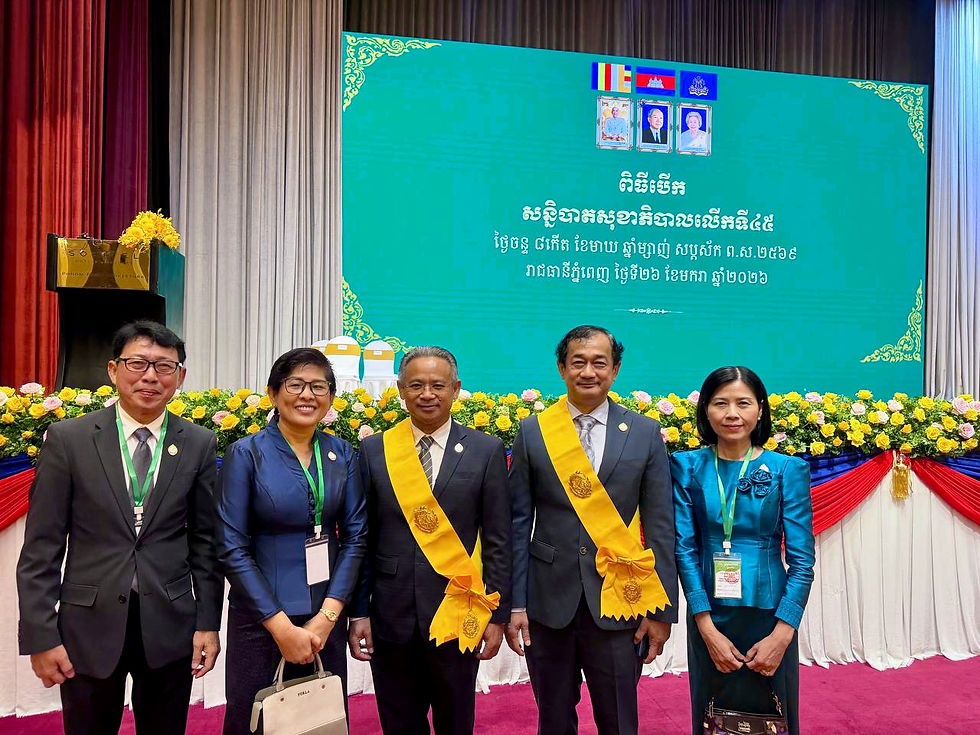
In January 2026, Yay Chantana and Ky Santy were awarded by the Cambodian Minister of Health for their outstanding achievements.
Prof. Dr. med. Yay Chantana
Before his studies, he worked as a night watchman in our hospital in Phnom Penh. Since 1992, he has also been active for Kantha Bopha as a doctor. After his studies, he went for further training in Boston (USA), returned, and expanded his knowledge – from basic care to heart surgery.

Prof. Dr. med. Ky Santy
Being a doctor is his dream job. After his studies, he started in pediatrics and soon switched to radiology. He further trained in this field, including in Marseille (France). In 1996, the first CT scanner in Cambodia was built and installed by Switzerland – and he got to work with it.


What an incredible story of hope and resilience for these children. The work done by the Kantha Bopha hospitals is truly inspiring. It makes me want to celebrate such big milestones! I've even used Hear me out to brainstorm some fun cake ideas for special occasions.
Nice collection of naming ideas. The name generator worked well for both gaming usernames and social profile nicknames.