
Milestones of Kantha Bopha Hospitals – yesterday and today
The video takes you on a tour of one of our hospitals.
The history of the Kantha Bopha hospitals is an impressive chapter in humanitarian aid. In 1992, Swiss pediatricians Beat Richner (1947-2018) and his colleague Peter Studer (1947-2020) rebuilt the hospital in Phnom Penh at the request of the king, which had been reduced to rubble after the war. In 1999, the Jayavarman VII Hospital opened its doors in the north of the country. Today, we care for around 3,000 children every day at both locations, with five hospitals and a maternity clinic, and provide over 2,700 jobs for local people.
Over the past 34 years, a network has been established that now treats around 85 percent of all sick and injured children in Cambodia free of charge. Child mortality in the country has fallen steadily during this period.
Child mortality under 5 years of age in Cambodia
1975 over 20 percent
1980 over 16 percent
1990 over 12 percent
2000 4.8 percent
2010 4.4 percent
2020 2.6 percent
Today 2.2 percent
For healthy hearts
In the early 1990s, the team primarily treated children suffering from malnutrition and infectious diseases such as tuberculosis, encephalitis, and dengue fever. In the case of tuberculosis in particular, it was important to treat not only those who were acutely ill but entire families to prevent them from infecting each other again.
This approach soon proved effective, with child mortality falling steadily to 4.4 percent in 2010. After careful analysis of the data, it quickly became clear that most of the remaining deaths were due to heart disease. This was the starting signal for Beat Richner's “Heart Project,” which he launched together with Prof. Oliver Kretschmar from the University Children's Hospital Zurich: In 2011, the first cardiac surgery department and the first cardiac catheterization laboratory for children in Cambodia opened in Siem Reap, and in 2019, cardiac surgery was also introduced in Phnom Penh. Today, more than 1,100 cardiac procedures and operations are performed annually.
Further training and modernization
Neonatology wards for premature babies with intensive care and nursing, as well as intensive care units for older children, have been established. Further training has been added in specialist areas such as gastroenterology (diseases of the gastrointestinal tract), visceral surgery (surgery on organs inside the abdominal and pelvic cavities), obstetrics and gynecology, nephrology (kidney diseases), orthopedics (musculoskeletal system), neurosurgery (surgery on the central and peripheral nervous system), and infectious diseases. In addition, imaging equipment has been continuously modernized to ensure accurate diagnoses, and staff have been trained in the latest techniques.
To this day, the continuing education of local staff is carried out by specialists from the University Children's Hospital Zurich and other Swiss hospitals. Depending on the topic, missions to Cambodia take place annually or every two years – however, teaching and professional exchange do not only take place during these medical missions on site, but throughout the year thanks to telephone meetings, video conferences, and email exchanges.
Hope for children with cancer
While leukemia in children has been treated in Phnom Penh for almost two decades, in the fall of 2023, under the direction of Prof. Felix Niggli, former chief physician of oncology at the Children's Hospital in Zurich, we also began treating other types of cancer, including liver, kidney, and brain tumors. A precise diagnosis is essential for the adequate treatment of such tumors. With the support of a pathologist from Switzerland, the previously rudimentary laboratory has been further developed in a targeted manner.
Even today, not all diagnostic options are available, and the therapeutic spectrum remains limited compared to Europe. Nevertheless, effective tumor control has now been achieved in several hundred children with cancer. In addition, there is close cooperation between the hospitals in Phnom Penh. This means that children who are treated at our hospital receive the necessary radiotherapy at another hospital in the city.
Video conferences are also held regularly in the form of tumor boards, where colleagues from Cambodia discuss individual cases with a team of experts from Switzerland. The progress made has finally made it possible to treat children with cancer at the Siem Reap Children's Hospital since fall 2025. Highly motivated teams at both locations are committed to caring for children with cancer with great dedication and within the limits of their resources. Since not all children can be cured, organizing dignified palliative care has also become one of their important tasks.
Farewell to the founders
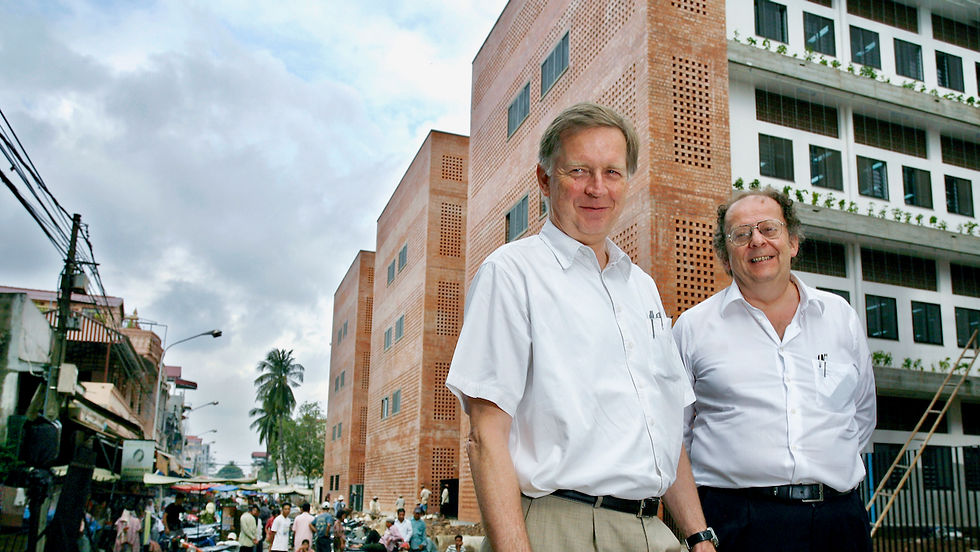
All these developmental steps have been taken gradually and were sensible and necessary from a medical point of view. Unfortunately, we have had to follow this path in recent years without our two founders: Beat Richner returned to Switzerland in 2017 for health reasons and passed away in September 2018. His good friend and companion Peter Studer passed away in May 2020.
What remains are their employees in Cambodia and the members of the Foundation Board in Switzerland—together, we have all continued to develop the hospitals in the spirit of the founders. The Kantha Bopha hospitals are the legacy of Beat Richner and Peter Studer – largely funded by Swiss donations, run with enormous dedication by the Cambodian hospital management, and internationally recognized. Lives are saved here every day. Sustainably, professionally, and with an eye to the future.
What does the future hold?

The high standards in the individual specialist areas will be maintained and optimized where necessary. Mental health has also become a focus in recent years: psychiatrists are now on duty at both locations for the children and are consulted whenever necessary for treatment.
For Prof. Dr. med. Ky Santy, hospital director in Phnom Penh, the planned introduction of hemodialysis for acute kidney failure is a ray of hope: “The new treatment will save the lives of children in critical situations.” He is also concerned about the well-being of his employees. New buildings have been constructed and renovations carried out to improve working conditions for staff and accessibility for patients. Prof. Dr. Yay Chantana, hospital director in Siem Reap, adds: “In all areas, strengthening professionalism, good clinical practice, patient-centered care, and patient safety remain a key priority in order to maintain quality and public trust.”
The Kantha Bopha hospitals also receive significant support and donations from Cambodia – from private individuals and institutions alike. In addition, there is the Cambodia Kantha Bopha Foundation, whose statutory purpose is to provide financial support to our hospitals. All of the foundation's activities and efforts contribute to ensuring the sustainable and long-term operation of the hospitals.
An overview of our hospitals
Phnom Penh | Siem Reap | |
Opened | 1992: Kantha Bopha I 1996: Kantha Bopha II 2005: Kantha Bopha IV 2007: Kantha Bopha V | 1999: Jayavarman VII |
Expansions and new offerings | 2015 Kantha Bopha I renovated and expanded with a museum, 2019 inauguration of the replacement building with a cardiac surgery center and two intensive care units for newborns and older children, September 2023 cancer ward opened | 2001 New maternity ward inaugurated, 2008 New extension, 2011 Opening of a heart center offering interventional cardiac catheterization, 2024 Expansion of the maternity ward by 200 beds and neonatology, May 2025 Cancer ward opened |
Beds | A total of 1,000 beds are available here for sick and injured children who need to be admitted to hospital | Pediatrics and pediatric surgery comprise around 900 beds, while the maternity clinic has around 200 beds |
Hospital management | General Director Dr. biol. Denis Laurent Director Prof. Dr. med. Ky Santy Vice Director Prof. Dr. med. Iv Malène Prof. Dr. med. Nguon Yaneth Prof. Dr. med. Tek Lyvannara | General Director Dr. biol. Denis Laurent Director Prof. Dr. med. Yay Chantana, Vice Director Prof. Dr. med. Khun Leang-Chhun Prof. Dr. med. Keo Sokha |
Patients | Around 3,000 children per day at both locations combined | |
Employees | A total of around 2,700 employees at both locations | |
Education | Our hospitals have been a department of the Cambodian Ministry of Health since 1994 and now serve as training centers for medical and nursing professions | |
Swiss students | As part of their elective study year, Swiss medical students have been able to work in obstetrics, pediatrics, and pediatric surgery in Siem Reap for two months since October 2024. In the summer of 2026, we will expand this program to Phnom Penh | |
The history from 1992 to 2023


I had been travelling and working around Delhi for a few days and wanted some time to relax. I found a convenient spa around Aerocity and decided to book a session. While looking for russian massage in delhi aerocity, I wanted a place with a comfortable environment and professional service. The staff was polite, the surroundings were peaceful, and the overall experience was relaxing. The location was also convenient for my schedule. I enjoyed the visit and found it a good option for some personal relaxation time.
When winter hits, wearing a north face puffer jacket ensures ultimate defense against chilling winds and frosty weather conditions. Crafted using advanced heat-retention technology, it balances breathability with robust insulation. You can easily layer it over sweaters or fleece tops without feeling restricted in your movements. Designed for long-lasting performance, this jacket remains a top pick among outdoor enthusiasts and urban commuters who refuse to compromise on either warm comfort or high-end style.
Good points here about choosing winter clothing that is actually practical. I think people sometimes focus too much on appearance and forget how often they will need to wear the jacket. I came across this North Face Puffer Jacket collection while searching and liked how many different styles were available. It gives you a better idea of what kind of puffer might suit your everyday wardrobe. Worth browsing if you are comparing options.
When it comes to iconic outerwear that seamlessly blends military heritage with urban streetwear, few garments command respect quite like a classic leather jacket. Originally designed to fulfill government contracts for military pilots needing ultimate durability in harsh flight conditions, these outerwear pieces evolved over decades into high-fashion statements. Today, wearing an authentic avirex leather jacket allows fashion enthusiasts to embody timeless Americana, bold graphic embroidery, and uncompromised craftsmanship that instantly elevates any casual outfit or street outfit.
Amazing journey of the Kantha Bopha hospitals! Such a great impact. I've found Faceless Reels really useful for creating similar short-form videos to share stories like this.