
Two months later …

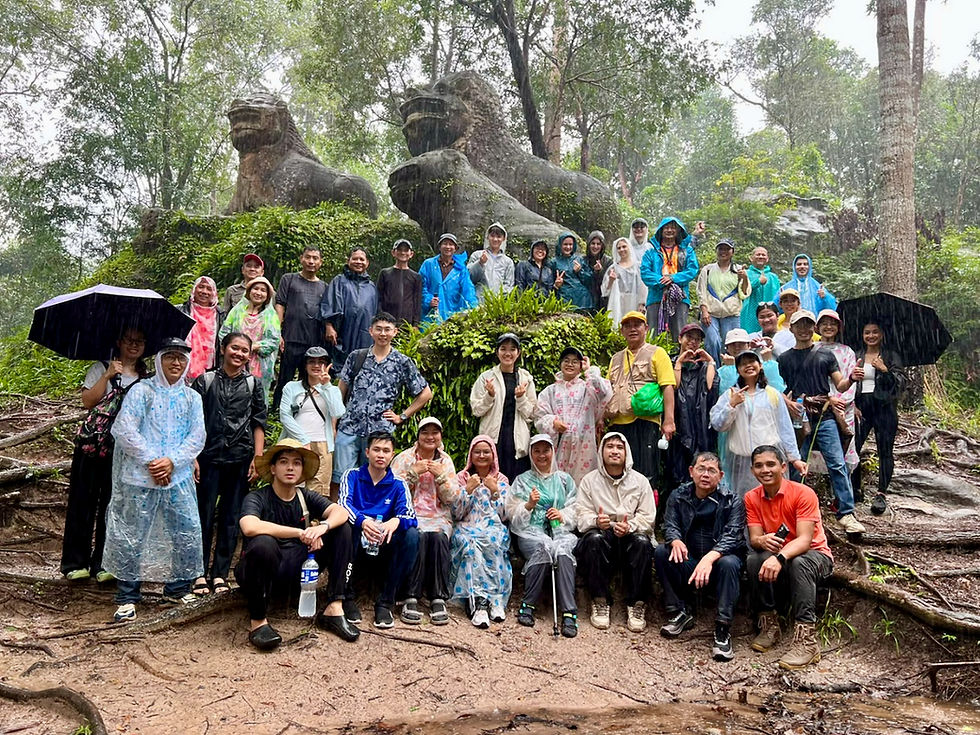
For two months, we had the opportunity to complete our clinical internship at the Kantha Bopha Children’s Hospitals in Phnom Penh. We look back on an incredibly educational, memorable, and enriching experience during which we not only expanded our medical knowledge but also gained many new perspectives on healthcare. From the very beginning, we were warmly welcomed by the hospital director, Prof. Santi, his deputy, Prof. Yaneth, and the entire team and integrated into the hospital’s daily routine. We were particularly impressed by the openness of the staff and their willingness to involve us in clinical work and share their knowledge with us, despite their enormous workload.
Already in the first week, we realized what a central role the Kantha Bopha Children’s Hospitals play in providing medical care in Cambodia. Every day, thousands of children receive outpatient or inpatient treatment, including many seriously ill patients who are referred to Phnom Penh from the provinces. The high number of patients and the heavy workload on the wards were particularly striking. During dengue season, for example, there are regularly far more children on the wards than there are beds available. In some cases, two or even three children had to share a single bed.
The intensive care units were also operating at high capacity. At the same time, we gained insight into the broad spectrum of medical conditions treated there, ranging from common infectious diseases to complex congenital malformations, severe neurological disorders, and cancer. We found it particularly remarkable that treatment is free for all children. This ensures that even families with limited financial resources have access to medical care that they otherwise could not afford.

During our stay, we had the opportunity to learn about various medical specialties and deepen our knowledge of pediatrics. At the beginning, we worked in the surgery department and on the pediatric wards. In the operating room, we were able to observe various procedures and also participate hands-on. We then spent several weeks in various intensive care units, where we cared for children with severe dengue fever, bronchiolitis, meningoencephalitis, multiple trauma, and complex congenital malformations. This experience helped us improve our clinical reasoning and taught us to assess disease progression more accurately and better understand therapeutic decisions. During our time here, the doctors repeatedly asked for our assessments. Afterward, they always took the time to discuss our assessments with us. This allowed us to effectively link theoretical knowledge directly to clinical practice.
Another important part of our internship was the neonatology unit. There, we learned about the care of preterm and newborn infants and were patiently introduced by the attending physicians to various clinical presentations and treatment options. We were particularly struck by how much the prognosis for a preterm infant can depend on the quality of initial care. Some children were brought to Phnom Penh from the provinces in a critical condition after they had previously been unable to receive adequate ventilation or the necessary equipment had been lacking. Upon arrival, some were already severely impaired due to prolonged oxygen deprivation.
We also became aware of the differences compared to care in Switzerland: While here in Switzerland, some children as young as 24 weeks’ gestational age receive intensive care, the threshold in Cambodia, based on our observations, is around 28 weeks’ gestational age. These experiences showed us how crucial good initial care, appropriate medical equipment, and the continuing education of healthcare personnel are.

On the cardiology ward, we also had the opportunity to delve deeply into congenital heart defects and echocardiography. Under the guidance of the doctors, we learned how to perform ultrasound examinations and identify various heart defects. We were deeply impressed by the large number of examinations and the regular heart surgeries taking place. We also gained valuable experience on the pediatric oncology ward. We learned about various types of cancer and their treatments and were allowed to observe explanations of chemotherapy, a bone marrow aspiration, and the administration of chemotherapy. In the process, we met children with very different chances of recovery. It was particularly difficult to witness situations where curative treatment was no longer possible. In such situations, we realized how important it is—in addition to medical care—to provide emotional support to the children and their families and to alleviate the symptoms of cancer.

In addition to the wealth of professional experience we gained, we were particularly concerned with how to manage limited resources. Although the staff work with great dedication and a high level of professional expertise, their options are sometimes limited by the available infrastructure and financial resources. For example, monitoring of children in the intensive care units was often done manually, and in the neonatal unit, some of the heat lamps attached to the cribs were no longer functional due to their age.
This disparity was also evident in diabetes care: For some of the children we accompanied, blood sugar monitoring could be performed only once a day, while continuous monitoring was not an option due to cost considerations. What we take for granted in Switzerland is not always available there. These observations reminded us once again that good medical care depends not only on the competence of the healthcare providers but also on the availability of appropriate equipment, medications, and supplies.
This is precisely why the importance of the Beat Richner Foundation became particularly clear to us during our internship. The fact that children can receive treatment free of charge, regardless of their families’ financial circumstances, is anything but a given. At the same time, we saw every day just how great the need is and how carefully the available resources must be used. Funding for medical care, the provision of appropriate infrastructure, and support for staff are crucial for hospitals to fulfill their vital mission. Our observations made us realize that behind every examination, every treatment, and every child cared for lies a significant organizational and financial effort.
Perhaps it is precisely because financial and technical resources are so limited that such great emphasis is placed here on training and the transfer of knowledge. During our stay, training sessions for medical staff and parents took place, and we were able to witness an exchange with a team of doctors from Singapore who presented their treatment approaches for dengue fever. Such encounters demonstrate how important collaboration across institutional and national borders is for improving the care of children in the long term.

We will also have fond memories of the people we met during those two months. Many doctors and nurses took time out of their demanding workdays to spend time with us, explain medical conditions, and guide us through our first hands-on experiences. We felt very welcome in the teams and were able to learn a great deal from them, both professionally and personally. A special moment was the memorial service marking the anniversary of the deaths of Dr. Beat Richner and Dr. Peter Studer, which was attended by staff from various departments of the hospital. It was evident just how deeply the two doctors’ commitment is rooted in the institution and how important their work remains for the local people to this day.
Looking back, our internship in Cambodia was a formative experience that helped us grow both professionally and personally. We were able to expand our knowledge in numerous specialties, acquire practical skills, and become familiar with many clinical presentations that we had not previously encountered in this context. At the same time, we learned to consider medical options more in the context of available resources and to better understand the challenges of a different healthcare system. We have gained a deep respect for the local staff, who, under conditions that are sometimes very demanding, care for an impressive number of children every day while demonstrating great professional and personal dedication.
We are very grateful to the Beat Richner Foundation for giving us the opportunity to have these experiences. Our heartfelt thanks also go to Hospital Director Prof. Santi, Prof. Yaneth, all the doctors, the nursing staff, and all the employees of the Kantha Bopha Children’s Hospitals who supported and guided us during our stay. Their openness, patience, and enthusiasm for medical work played a key role in ensuring that we were able to gain so much from these two months.
We return with deep gratitude, many valuable experiences, and an even greater appreciation for the work of the Kantha Bopha Children’s Hospitals.
With warm regards,
Romain and Melina


Thank you for sharing your reflections two months later! I’m really curious about the evolution of the ragdoll hit concept you mentioned. How do you see it influencing the community's engagement moving forward? It resonates with me since I often find creative paths can lead to meaningful connections. Looking forward to hearing more!
Create a coherent long-form piece, travelog, or personal memoir that reflects on your medical trip or residency experience by combining these posts wordle unlimited For a professional presentation, grant report, or blog series, polish the text to improve the narrative pace, tone, or emotional resonance.
Thank you for sharing this update and keeping supporters informed. A PNG to editable PowerPoint converter can also help turn visual updates into customizable slides for nonprofit presentations.
Students who enjoy programming can explore how software helps solve problems in different industries. Coding involves logical reasoning, structured thinking, and repeated testing. Building small applications or solving practice nitmeghalaya exercises can help beginners improve gradually. Understanding the fundamentals before moving to complex projects often makes the learning process more effective and less overwhelming.
Ganz so einfach ist es wahrscheinlich nicht, aus zwei Monaten Praktikum schon alle Seiten eines Gesundheitssystems zu verstehen, aber gerade die Einblicke in den Alltag der Kantha Bopha Children’s Hospitals in Phnom Penh machen den Bericht interessant. Neben dem medizinischen Wissen bleibt offenbar auch die Erfahrung hängen, wie wichtig ein gutes Team und unterschiedliche Perspektiven im Klinikalltag sind. Bei Online-Angeboten wie casinoauslandonline.ch lohnt es sich ebenfalls, genauer hinzusehen und die Bedingungen zu prüfen, statt sich nur vom ersten Eindruck leiten zu lassen. Am Ende zählt, was hinter der Oberfläche steckt.