
What shapes people

It has now been a few weeks since I returned to Switzerland after my assignment for the Beat Richner Foundation. Cambodia as a country and its healthcare system have left an impression on me that will stay with me for a long time to come.
The combination of heat, humidity, and noise creates a constant background noise every day. Machines, patients, parents, the team—everything sounds at once. Even after several days, it feels as if my senses are still overwhelmed: on the left, a crying child; on the right, a cell phone playing children's videos much too loudly. And opposite me, a doctor trying to explain, in a language that is not our native tongue, which clinical pictures are currently common in the intensive care unit. At this time of year: dengue fever. And, again and again, the ever-present traffic accidents.
Looking back, the days are actually quite short. Starting at seven, with a lunch break from 11:30 a.m. to 2:00 p.m., there is enough time to take a breather, eat something, and maybe even squeeze in a nap before diving back into the afternoon. And yet, every single day is intense. Often, you are only assigned to the same ward for a few days before the faces of the doctors and nurses change again. New teams, new patients, new problems, and just when you think you've found a rhythm, it shifts again.
Everyday hospital life is also reflected outside the walls. Parents of patients who are not allowed inside wait around the grounds. In between are mobile food stalls, whose fried smells carry far, and children playing on the side of the road as if there were no better place to be. Cambodia pulsates. A constant stream through cities and streets, loud, warm, lively.

And somewhere in this stream, as a Swiss student in the middle of your education, you have to find your role. You are a guest and yet somehow right in the middle of things. You are supposed to learn, you are encouraged, sometimes even challenged. But it must not become an end in itself. Where can I help? Where is restraint the more professional decision, so that you don't cause damage through overzealousness that would affect a young person for many years to come?
I don't have any perfect stories from these weeks. I don't think there are any. But I do have images and impressions: focused faces, humor no matter what the situation, fatigue in a system that demands an incredible amount. And I have great respect for people who carry a heavy load day after day. Often silently. Often with a matter-of-factness that impressed me.
After weeks that increasingly blurred into one another, I wanted to get to know the country outside the hospital, not just from a distance and in the moments between my accommodation and the hospital grounds.
During this time, night buses, vans, and patience became my faithful companions. For a week, every morning was a different place, and every day was filled with journeys and experiences that will stay with me for a long time to come.

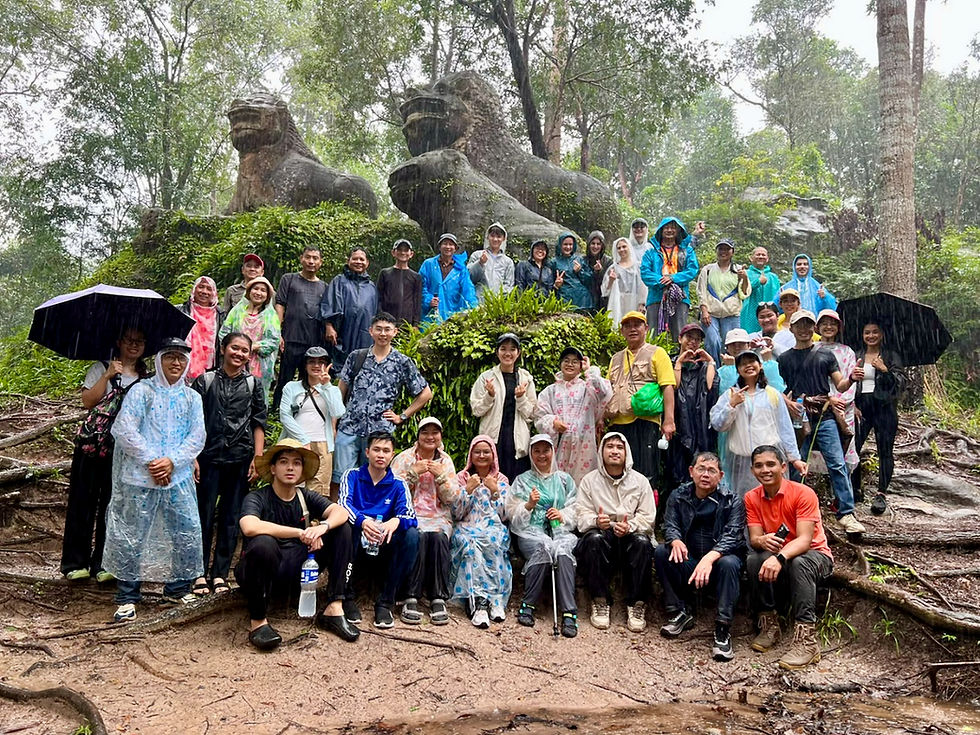
One highlight was the nearly 48 hours I spent in an almost untouched jungle in a remote region of the country, accompanied by a guide from the Bunong tribe. An organization has owned a large piece of land there for several years, which it uses to take in elephants from Cambodia and neighboring countries such as Vietnam. Many of these animals were used as working animals in villages and have years of hard physical labor behind them.
The project is financed by tours for tourists who spend time with the elephants, feed them, or bathe with them in the river. And here, too, one cannot avoid the thought that as a tourist, one takes on a strange dual role, being both part of the problem and part of the solution. Ideally, animals and forests would simply be left alone. Even in a protected environment, cigarette butts from visitor groups sometimes emerge from the mud. And yet it is precisely this work that is only possible because the tours finance it.

However, by far the most impressive part of the trip for me was S-21 and the Killing Fields in Phnom Penh, sites of violence from the Khmer Rouge era. Rooms full of pictures, names, and stories of people who were held there and never left the building alive. It is a piece of the country's history that many older Cambodians experienced firsthand and that is often passed on to younger generations without being spoken about.
When I was told in the hospital that mothers in the delivery room often did not make a sound for fear of the Khmer Rouge, I couldn't imagine it at first. At the time, I didn't understand what happened during that period if you attracted negative attention in any way. After visiting S-21 and the Killing Fields, the terrible realization dawned on me.
When I returned to Siem Reap after that week, the hospital was the same. The city was the same. And yet, many things felt slightly different. Perhaps because, outside the clinic, I had gained a better understanding of the country in which this medicine is practiced. Perhaps also because S-21 and the Killing Fields had given the word “dignity” a different meaning.
This week away was not an escape from everyday hospital life but an extension of it. It showed me how much a country can endure and still carry on. And it made me realize that the work in the hospital does not take place in a vacuum but in the midst of a society that carries its history with it. Perhaps that is the most important lesson of these two months: that medicine is not just treatment but always an encounter with what shapes people.
With warm regards
Jason


This is a good read, and I appreciate the clear wording throughout the post. Anyone interested in a challenging game can explore the geometry wave experience and see how it feels. The movement and obstacles make each attempt engaging, while learning the paths takes patience. I like games where you can try again, understand your mistakes, and gradually make progress through the more difficult sections.
I found your exploration of the factors that shape individuals deeply intriguing! Slope Run How do you think cultural influences compare to personal experiences in shaping one’s identity?
Navigating a chaotic ICU environment feels like a high-stakes X Trench Run, but your humble perspective on Cambodian history and human dignity really resonated with me.
Excelente entrevista y una presentación muy interesante del álbum debut de Michael Marcagi. Se nota la pasión y autenticidad detrás de cada canción. Además, para quienes buscan información útil, Horario De Las Loterías puede ser un excelente recurso. ¡Gracias por compartir este gran contenido musical!
Your experience in Cambodia sounds truly eye-opening. The RD Calculator would be a great tool to help manage the overwhelming sensory input in such a bustling environment. I'm curious, how did the local healthcare workers adapt to these conditions?