
Magic happens here
This year started differently than usual for me. Instead of sitting in cold Switzerland, I am now here in Siem Reap, a small, often underestimated town. From the very first moment, I felt how lively this city is and how open and warm the people here are.
A friend of mine had recommended that I spend part of my elective study year at Kantha Bopha in Siem Reap—he himself was very enthusiastic about his stay there. So I came here with high expectations. Nevertheless, the hospital surprised me again in a positive way. On the very first day, during the tour of the hospital, I had a special feeling that was confirmed again and again in the weeks that followed. It is something you don't forget so quickly.
As I walked through the long corridors for the first time, I felt a deep sense of gratitude. Hope and trust were evident in the eyes of the people. Even today, I still walk through these corridors every day and see how the patients sit there with confidence, even though many of them are very ill. This confidence stems from the great trust they have in the staff and medicine at Kantha Bopha Hospital, because patients here have always received excellent care for many years.
The morning report mentions the number of cases: Over 1,000 patients are in the hospital every day and receive treatment there. This number is not unusual but rather slightly lower than normal, as it usually rises further during the rainy season. One of the reasons this high number of patients is possible is because the hospital is very spacious.
Patients can wait anywhere on the grounds, often in the shade of the many plants. This also impressed me particularly: I could never have imagined that a hospital could be so beautiful. The architecture, combined with the lush vegetation, gives the place a lively and calming atmosphere. Both in the hospital and in the temples throughout Cambodia, it is clear how closely nature and buildings are interwoven here. This is something I find particularly beautiful.
From left: View after leaving a patient's room. On the way to the morning briefing. Ta Prohm Temple.

Passing by the many people waiting every day, I really began to realize the scale of this hospital. Several times I was close to tears because I realized what is achieved here every day.
Of course, the hospital is inextricably linked to the names Beat Richner and Peter Studer. Their life's work laid the foundation for everything that is possible here, and personally, I find it deeply inspiring to see the impact that individuals with a clear goal can have on so many lives. At the same time, it is equally impressive to see how this work is being continued today by doctors, nurses, midwives, therapists, and all the other staff who care for the children and their families with enormous dedication every day. The gratitude towards Beat Richner and Peter Studer is still palpable, not least because there are pictures of them in almost every room.
Every day, the hospital shows me what medicine can achieve: that it not only helps individuals but can also influence entire lives and countless other destinies. My stay here has personally reinforced my decision to study medicine. I can see how many people are being helped here and how universally medicine can be applied, regardless of where you are in the world.
Kantha Bopha is well known throughout Siem Reap. When you talk to people, many tell you that their own child was born here. In a brief conversation at the hospital, one man said to me: “This here is like magic. I tell everybody they should go to Kantha Bopha, because magic happens there.” After my first month here, I can only agree: something very special does indeed happen every day at this hospital.
As impressive as the hospital is as an institution, the people who work here are even more impressive. Regardless of their position, you encounter friendliness, competence, and a great willingness to share knowledge everywhere you go. Two phrases I hear over and over again here, whether at the market, in the hospital, or during guided tours, are: “why not” and “no problem.” For me, they reflect the pragmatic and at the same time very open nature of the people in Cambodia. Instead of focusing on why something is not possible, they almost always look for a simple and feasible solution first.
I really like this attitude to life because it focuses on possibilities, on what can be done, rather than on prohibitions or limitations. At first, I was a little afraid that too much would be expected of me and that I might make mistakes as a result. Over time, however, I realized that although a lot was expected of me, I was always well supported and the well-being of the patients was never compromised. In addition, it is always accepted when I say that I would like to take a closer look at something first or make sure I have all the information I need.
At the hospital, knowledge is not only gladly passed on but also actively absorbed. Teams from Switzerland regularly visit Kantha Bopha Hospital to teach local staff or jointly examine new medical techniques. Coincidentally, two such missions were on site during our first month, and we were able to accompany them for two weeks. It was very exciting for us students to observe how this professional exchange takes place. The great thirst for knowledge among the local staff is particularly striking: they are very interested in new methods and extremely willing to learn and further their education. This exchange was also very valuable for us, as both teams were able to teach both the local students and us a great deal.
During my first month, I spent two weeks in the maternity ward, one week in the pediatric and neonatal intensive care unit, and one week in cardiology.
In cardiology, for example, I was able to observe Dr. Stambach in the ultrasound room, where a large number of patients are examined every day. Many only come to the hospital when they already have symptoms. As a result, you see clinical pictures that are rarely encountered in Switzerland today, such as clubbing of the fingers, which develops as a result of years of cyanosis. Congenital heart defects are also often clearly audible, as they have sometimes gone untreated for a long time. However, in an interesting conversation, I also learned that some patients now come in with only muscular chest pain, for example, and want to have it checked out because they are concerned. The fact that people are now more likely to come in than they were ten years ago is also a testament to the good medical care and the growing trust in Kantha Bopha.

I spent two weeks of my first month in the maternity ward. Here, I became particularly aware of the enormous variability of life. On average, around 60 children are born here every day. You walk through the corridors, see all the pregnant women carrying new life inside them, go into the delivery rooms and witness one birth after another. I was allowed to assist with a birth in my very first week. I was overwhelmed, but I received excellent guidance and was able to help the mother bring her child safely into the world. When I saw the newborn in the mother's arms and her beaming face, I was overjoyed. I will remember that moment forever.
At the same time, my thoughts continued to wander. The woman I had just helped was herself still a child, only 14 years old. This made it all the more important that she received good medical care here and was able to give birth to her child without complications.
In addition to the maternity ward, I also spent a week each in the MPICU and the neonatology department. There I saw many newborns with asphyxia, i.e., oxygen deprivation during birth, as well as children with severe malnutrition who may suffer lifelong consequences. It is striking how many people already bear the burden of fate before they are even able to make their own decisions. This thought preoccupied me particularly during my time in the maternity ward and the intensive care units: how differently a life begins, depending solely on where you are born. It is all the more comforting to see the commitment, expertise, and calm with which the teams treat these children.
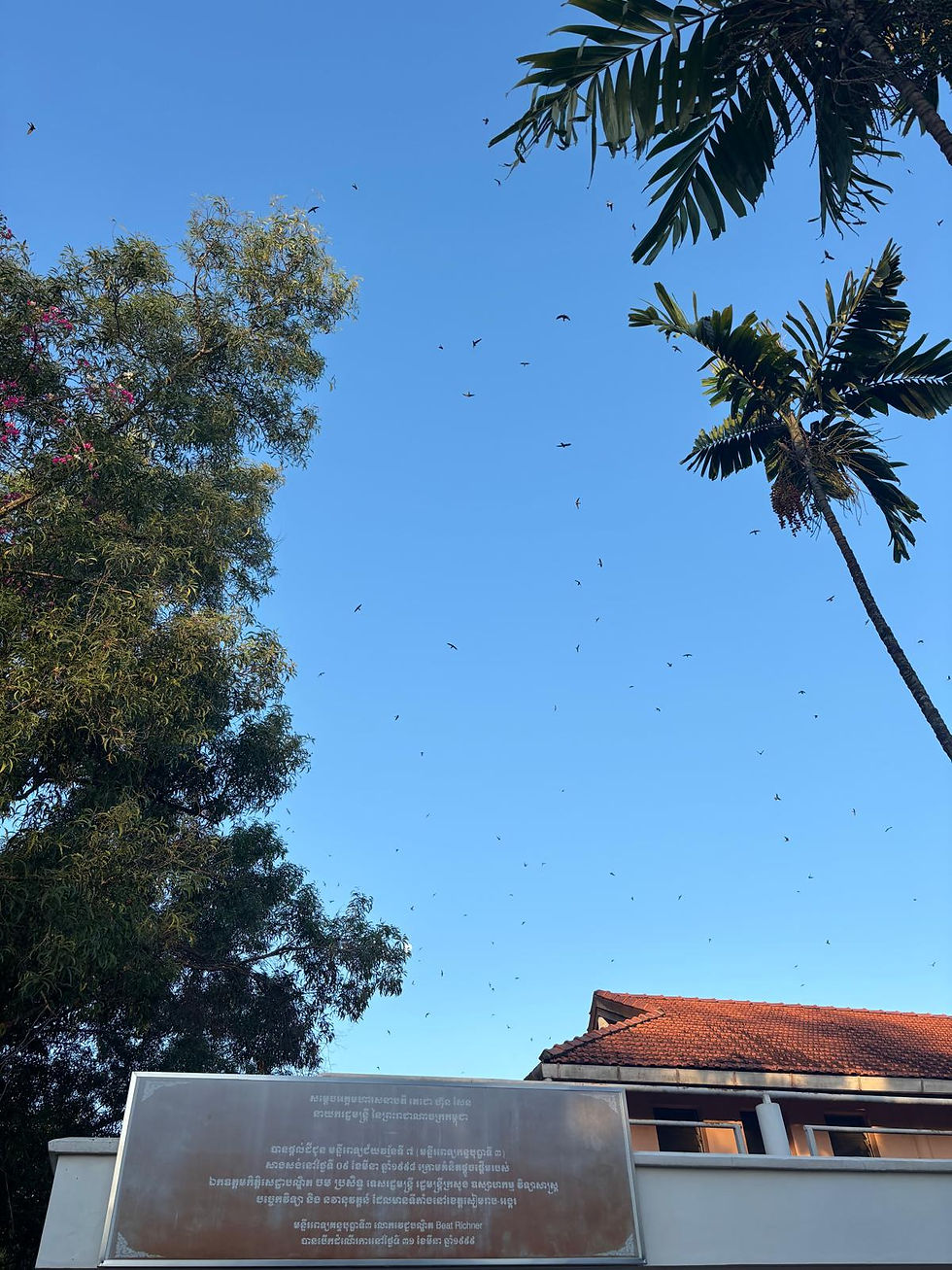
When I leave the hospital in the evening, I often think of the many swallows that circle above the grounds every morning. In the past, people believed that they only bred in places where true peace reigned. They were called “the dove of the little man,” a symbol that finds its deepest meaning here: since all treatment is free of charge, even the poorest have access to cutting-edge medicine. It is a place where social background plays no role and the dignity of the child is the focus.
For sailors, the first swallow on the horizon was a sign of the safety of the harbor; after harsh winters, it was a promise of a new beginning. I couldn't imagine a better place for them. Because in the midst of difficult circumstances, this hospital is exactly that: a haven of peace, a place of hope, and for so many children, the beginning of a new, healthy life. Here, the magic of the swallow is not an old legend but a reality that is lived every day.
When I arrive home after a long day, I am often exhausted from the many impressions. At the same time, I am infinitely grateful to be able to have this experience and grateful to all the people there who welcomed me so warmly.
With best regards from Siem Reap
Luis


Beautiful reminder that magic really does happen in the ordinary moments. We clean up our team notes with a quick markdown to text step before sharing docs, and small tools like that make a surprising difference.
Network administration becomes less confusing when information is presented with practical examples. Anyone exploring 1.0.0.0.1 can use the topic as a starting point for learning about router access, configuration, and common solutions for network-related issues.
The perfect plan in Scary Teacher 3D only stays perfect until the first unexpected sound, after which it becomes a survival improvisation exercise inside her entire house.