
Why we should hit each other more
“We have to hit each other in Switzerland.” I come to this conclusion with a smile as I walk out of the ward after a day at the MPICU (Mother-Pediatric-ICU).
At this point, I had spent about a month in Cambodia at Kantha Bopha Hospital, working in the maternity ward, the surgery ward (pediatrics), and the MPICU. Before that, I was able to enjoy a few days of vacation and celebrated New Year's Eve here in Siem Reap. That evening, we had our first real contact with the locals and exchanged a few words, as best we could. It didn't take long before the first friendly pats on the back were exchanged, hands were placed on shoulders, and “slaps” were given. Such friendly slaps were nothing new to us, but here the threshold seemed to be lower.
We went from table to table, clinking glasses with most people (“chol moii”) and if you were invited to the table, it didn't take long before you got your first hug. However, one should not think that this affectionate contact was only directed at us. Among themselves, they poked, slapped, and pushed each other just as much as they talked. After such a welcome to our new temporary home, we were all the more excited to find out what life in the hospital would be like.
The first few days at Jayavarman VII blew me away with the many intertwined emotions. Words like awe, emotion, or perhaps even humility come to mind. You feel that you have become part of something very special. During my first tour of the hospital, these feelings intensified so much that I was close to tears when I thought about what a beneficial institution had been created here. For example, when Denis Laurent (CEO of Kantha Bopa Hospitals) addresses the staff and promises to work for good working conditions. In moments like these, I realize once again that the vast majority of employees here work out of conviction and that they, like me, feel part of something bigger and more important.
When the initial intensity of Beat Richner's work had faded after a few days, I recognized the now familiar fighting. Here, it was between the staff. Between nurses and doctors. Between a cleaner and us Swiss interns. Between the chief surgeon and the scrub nurse. Everyone hits each other. At first, I wasn't hit. Unlike on New Year's Eve, you have to earn your beating without the New Year's Eve euphoria. As soon as I mastered the Khmer basics with “What's your name?” (“chmua ey”), “How are you?” (‘soksabai’) and “Happy, happy!” (“sabai sabai!”), the cadence of hands on my shoulder and friendly squeezes on my upper arm increased rapidly, and the long-awaited slap on the back was not long in coming.
However, these small gestures changed more than just the culture of greeting. This physical naturalness created trust. So when I stood in an operating room where the doctor had briefly patted me on the shoulder beforehand or even just tapped me while explaining the upcoming case, it was easier to actively participate. There was practically no fear of asking the wrong questions. Although the doctor had the responsibility and the final say, everyone else was always treated as an equal. Everyone was listened to.
So this small gesture had a big impact after all. Perhaps it is symbolic of a functioning, pleasant working environment. A structure in which I would like to be employed. One in which familiarity and professionalism do not contradict each other but reinforce each other. By meeting on equal terms, taking responsibility, and still allowing closeness. Perhaps this is precisely what creates the trust that not only makes it easier to ask questions but also makes dealing with mistakes more honest.
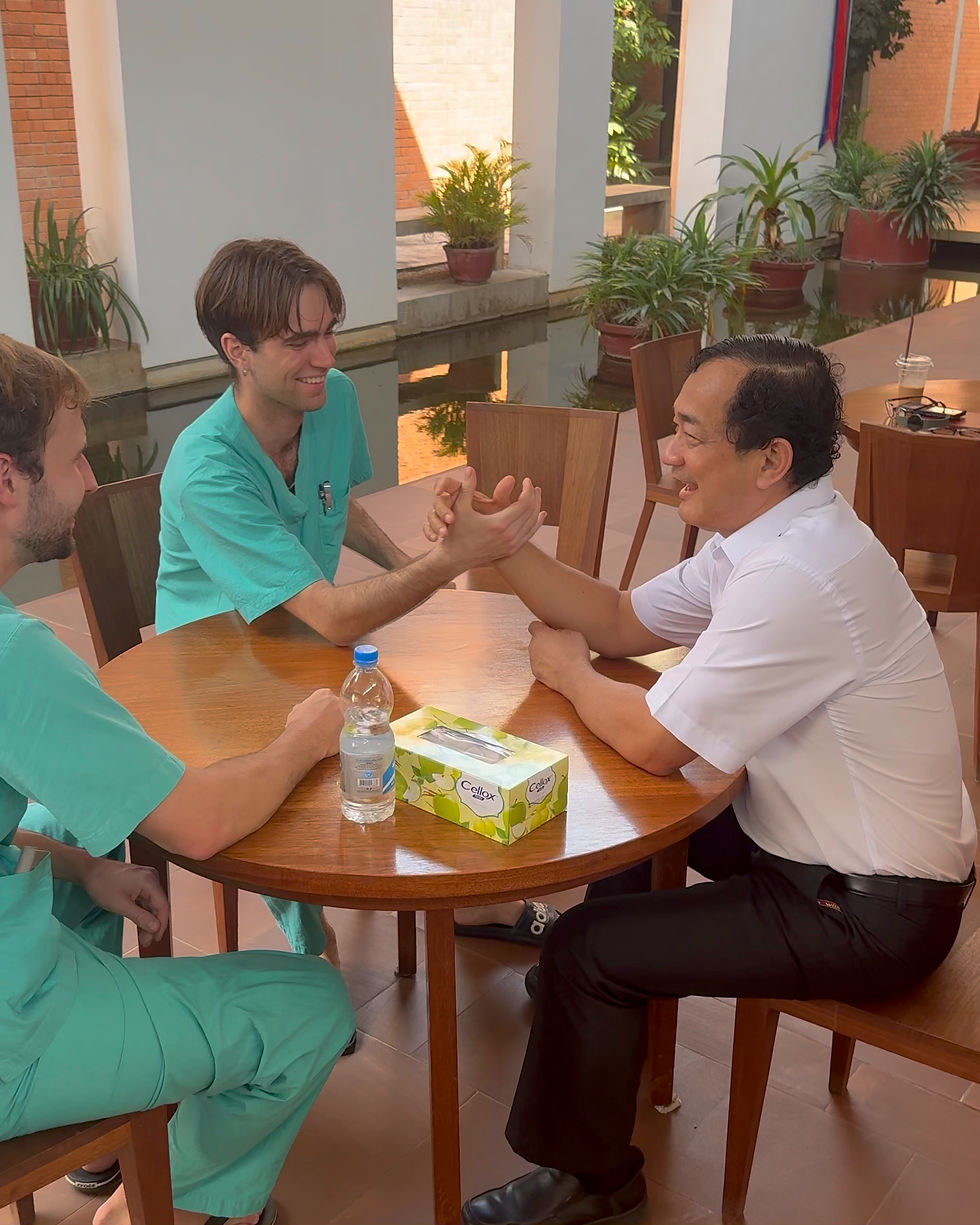
Note to self: Stay away from stations with unfeeling pacifism. Such an attitude certainly did not prevail at the MPICU mentioned above. Dr. Nai beat me here from the very first minutes (I use this word deliberately, as Nai does not hold back in some cases).
I also remember another scene while writing this text. Namely, when we held an arm wrestling competition one afternoon with the directors, including Prof. Chantana (director of Jayavarman VII). I have a picture of this that I don't want to keep from the outside world.
So we've come full circle, back to where I want to give the Swiss people a better understanding of the Hau culture. I'm a big fan of Switzerland and us Swiss, but I don't think a little bit of Khmer (Cambodian) would do us any harm.
Best regards
Bjarne


What a moving story! It sounds like such a profound experience working in Cambodia. After reading something so deep, I usually need to unwind with Chainsmoker Cat Manga just to lighten my mood a bit. Thanks for sharing your journey!
Nice collection of naming ideas. The name generator worked well for both gaming usernames and social profile nicknames.